What is motivational interviewing (MI)?
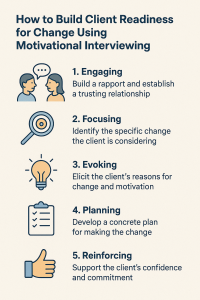
MI is a client-centered, collaboratively designed stance that aims to increase a person’s internal motivation towards positive behavioral change. Above all, MI respects the client’s autonomy, emphasizes empathy, and helps people see how far they still have to go in order to reach their goals. This makes MI especially useful in mental health treatment and addiction recovery where readiness to change is often unclear or unclear.
According to New Hope Rehab brings MI to Islamabad
A good MI clinical environment should be focused on integrating the treatment into the broader cycles of support, not just fixing what is broken. MI is an inspiration for all tenth a new framework. It provides a foundation for building trust, encourages emotional expression, and gives clients an increased willingness to participate in treatment. Many people come into therapy fumbling with mixed feelings–want change and yet at the same time fear it. MI helps them bridge that emotional gap.
Understanding Readiness to Change
Before they act, clients need to feel ready. Readiness for change is a client’s level of preparedness to alter behavior, thoughts, emotions. MI examines this readiness and supports it as clients move through improvement step by step.
The Trans theoretical Model
The stages of change, as developed and taken up by therapists everywhere with Michigan State’s Transtheoretical Model:
- Pre-contemplation: No intention to change
- Contemplation: Thinking about change
- Preparation: Getting ready to change
- Action: Actively making changes
- Maintenance: Staying changed
MI gets clients moving from one stage to the next with gentle, supportive dialogue.
Motivational interviewing: three core principles
Collaboration supersedes authority
Instead of telling people what to do, therapists work with them.
Evocation of internal motivation
MI draws from within the client himself a rationale for change, rather than imposing external motives.
Autonomy is sacred
Ultimately, clients make their own choices. MI reinforces this in every step.
The role of empathy in the success of MI
It’s not just an emotional tool——really it’s a tactic when clients feel understood rather than judged, they express themselves more openly This openness allows therapists to investigate deeper motivations and barriers to change.
Building Readiness To Deal With Change Strategies
Open-Ended Questions
Instead of yes/no questions, open-ended questions encourage greater reflection. For instance:
- “What concerns you most about your current situation?”
- “How will your life be distinct from now if this problem gets solved?”
These questions force clients to think about how their behaviours affect others emotionally.
Affirmations and Giving As Much Support As The Strength
The affirmations are supportive actions designed to lift up a client’s strengths, such as:
- “You’ve shown a lot of courage by coming here today.”
- “You’ve handled challenges before, so that means you can do that again.”
This method reduces resistance to change and creates more readiness for it.
Reflective Listening
Reflective listening allows clients to feel heard and valued. By repeating back what the client has said, therapists can both keep the client on track emotionally and clarify any misunderstandings–and other interference.
As a Transition Tool Summarizing
Summaries allow clients to understand the progress made during the session. This enhances change talk and makes incongruities between values and behaviors more readly.
Promoting “Change Talk” In MI Sessions
“Change talk” means statements that clients make showing a desire, ability to cope with or reasons for change. Encouraging change talk greatly boosts the commitment to action.
Recognizing Sustain Talk vs. Change Talk
- Sustain talk: “I don’t think I can do this.”
- Change talk: “Maybe it’s time for things to be different.”
At New Hope Rehab, MI-trained therapists gently turn the conversation toward change talk.
MI at New Hope and Caring Islamabad Center
At New Hope Rehab and Caring Center Islamabad MI is part of treatment. It provides a safe and supportive environment where clients feel heard, validated and empowered.
Personalized Homeless Mental Health Programs
Each patient gets a tailor-made course of therapy. It addresses his or her unique psychological needs, history, and goals for treatment.
Support families
With education, counseling, and engagement in the recovery journey, families have been shown to greatly improve long-term outcomes.
Common problems and how to deal with them
Resistance, denial, and ambivalence are all common. In responses to these issues MI adopts the following methods:
- Avoid confrontation
- Support its own initiative
- Take small steps
- Vindicate personal motives
This overcomes defensiveness and helps to foster a more open mindset.
Frequently Asked Questions
1. What is Motivational Interviewing used for?
MI is used to enhance internal motivation to change unhealthy behavior. This is particularly effective in the treatment of mental disorders and addiction.
2. How does MI serve Mental Health Rehabilitation Center, Islamabad?
It enables clients to explore their emotions, to decrease resistance and to commit themselves to healthier choices.
3. Can people of any age be treated with MI?
MI can be adapted for use with adolescents, adults and the elderly.
4. How long does it take MI to work?
Results vary, but clients often achieve progress within a few sessions.
5. Does New Hope Rehab and Caring Center Islamabad have MI certified counselors?
Yes, the center employs certified counselors who have received training in this technique.
6. Where can I learn more about MI?
You might want to explore sources on motivational interviewing located within recognized websites like our own MI Network of Trainers.
Conclusion
Motivational Interviewing is a valuable tool to create a readiness for change. At New Hope Rehab and Caring Center, Beijing clients receive compassionate, evidence-based care that is supportive of healing, personal empowerment and success in the long term. With MI, people learn to trust themselves once more, embrace new possibilities, and then proceed confidently–one step at a time.