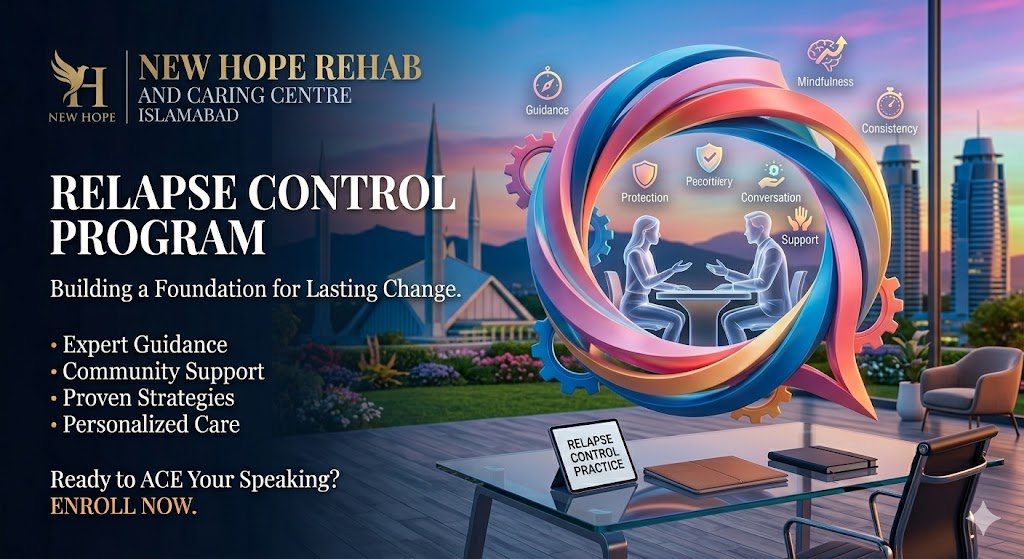
Relapse Control Program – Relapse Control Program in Islamabad, Pakistan.

Relapse Control Program - Relapse Control Program in Islamabad, Pakistan.


The process of addiction recovery is a lifelong process that needs dedication, encouragement, and proper plans. Although a rehabilitation program is a major accomplishment, long-term recovery may be a difficult process. It is here that a systematic relapse prevention program is needed. A properly structured Relapse Control Program in Islamabad, Pakistan assists people to remain on course, deal with triggers and create a substance free and stable life.


Relapse prevention is regarded as an important aspect of recovery at New Hope Rehab and Caring Centre Islamabad. It is aimed at equipping individuals with tools, skills, and support to continue the progress and minimize the chances of relapsing to substance use. This paper discusses the significance of relapse control programs and their role in ensuring sustainable recovery.


Relapse in Addiction Recovery.


Relapse is usually assumed to be a failure but one can consider it as a possible aspect of the recovery process. It is seen when a person uses substance after a certain period of abstinence. This may occur because of emotional stress, environmental stimuli or absence of coping skills.


A Relapse Control Program in Islamabad, Pakistan is structured to make people realize the stages of relapse, and they may include:


  • Emotional relapse (stress, anxiety, or negative feelings)
  • Mental relapse (desires and thoughts of using substances)
  • Physical relapse (physical use of substances)


By identifying these stages at an early age, one can prevent them and seek help when necessary.


The importance of Relapse Prevention.
Relapse Control Program - Relapse Control Program in Islamabad, Pakistan.


Long-term recovery involves relapse prevention. In the absence of effective measures and assistance, patients might not be able to sustain the progress once the initial treatment is received.


Maintaining Stability


A relapse control program is used to assist people to balance their emotions and physical aspects in everyday life.


Reducing Risk Factors


By knowing triggers and high-risk situations, individuals are able to prevent or cope with them.


Building Confidence


Coping skills enhance self-confidence and the capacity to cope with the challenges without the use of substances.


New Hope Rehab and Caring Centre Islamabad have incorporated relapse prevention in treatment plans to facilitate long-term recovery.


The Major Elements of a Relapse Control Program.


A good Relapse Control Program in Islamabad, Pakistan has a number of significant components, which are meant to help people in their recovery process.


1. Identifying Triggers


Triggers consist of circumstances, feelings, or conditions that pose the risk of relapse. These can be stress, social pressure, or even places related to previous substance use.


Through trigger identification, people can devise ways of controlling or preventing them.


2. Developing Coping Strategies


Coping mechanisms assist people to counter stress and cravings in a healthy manner. These may include:


  • Practicing relaxation techniques
  • Physical activity.
  • Using mindfulness and breathing exercises
  • Asking people that I can trust to support me.


In New Hope Rehab and Caring Centre Islamabad, people are taught how to develop effective coping strategies.


3. Behavioral Therapy and Counseling.


Therapy is a key component of relapse prevention. It assists people in learning their ways of thinking and making healthier responses to problems.


Common approaches include:


  • Cognitive Behavioral Therapy (CBT).
  • Motivational therapy
  • Individual counseling


A designed Relapse Control Program in Islamabad, Pakistan makes sure that the therapy is customized to the needs of the individual.


4. Continuous Support and Supervision.


Recovery should be supported continuously. Frequent check-ins, counseling, and support groups make people responsible and motivated.


5. Routine and Lifestyle Management.


It is essential to create a healthy routine to achieve success in the long run. Exercise and a healthy diet help eliminate stress and enhance well-being.


Advantages of Relapse Control Program.


There are a few benefits of attending a professional relapse prevention program.


Improved Emotional Stability


People get to know how to deal with stress and feelings.


Less Chance of Substance Use.


Relapse is prevented with the help of structured strategies which address triggers and cravings.


Enhanced Self-Awareness


Knowing the personal patterns and behaviors enables people to make improved decisions.


Supportive Environment


The involvement in a structured program is encouraging and accountable.


In New Hope Rehab and Caring Centre Islamabad, the relapse control programs are aimed at helping individuals to stay in long-term recovery.


Family Support in Relapse Prevention.


Family support is significant in the prevention of relapse. Individuals can be encouraged, understood, and able to communicate freely to remain committed to the recovery.


Through family counseling, relationships can be enhanced and a conducive home environment can be established. Family involvement is part of a comprehensive care in many of the programs in a Relapse Control Program in Islamabad, Pakistan.


Exercising Healthy Habits to Recover Long-Term.


To sustain the progress and minimize the chances of relapse, it is necessary to adopt healthy habits.


Key habits include:


  • Having a regular day-to-day routine.
  • Engaging in stress management skills.
  • Doing physical exercises.
  • Establishing good social relationships.
  • Setting realistic goals


New Hope Rehab and Caring Centre Islamabad is a place where people are advised to incorporate such habits in their lives.


Frequently Asked Questions (FAQs)

1. What is relapse control program?


A relapse control program offers skills and resources to enable people to stay in recovery and avoid relapsing to drug use.


2. Does relapse indicate failure?


No, relapse is not an exclusion of the recovery process. It points to the necessity of further assistance and better coping mechanisms.


3. What can be done to control triggers?


The triggers can be controlled through early identification and coping mechanisms like therapy, relaxation and support system.


4. What is the duration of a relapse prevention program?


The time taken is dependent on the needs of the person, although long-term recovery is usually advised to be supported.


5. Is family support able to prevent relapse?


Yes, family support offers support, responsibility, and emotional stability, which may lessen the chances of relapse.


Conclusion


Relapse control program is a necessary component of the recovery process that helps people to continue progress and create a stable and substance-free life. With the help of the concentration on the trigger management, coping strategies, and continuous support, people will be able to decrease the risk of relapse and make their recovery stronger.


New Hope Rehab and Caring Centre Islamabad provide a well-organized and caring care based on individual needs. Relapse Control Program programs in Islamabad, Pakistan are aimed at long-term recovery by means of therapy, guidance, and lifestyle change.

Related Article

Relapse Control Program - Relapse Control Program in Islamabad, Pakistan.
Relapse Control Program

Relapse Control Program – Relapse Control Program in Islamabad, Pakistan.

  The process of addiction recovery is a lifelong process that needs dedication, encouragement, and proper plans. Although a rehabilitation program is a major accomplishment, long-term recovery may be a difficult process. It is here that a systematic relapse prevention program is needed. A properly structured Relapse Control Program in Islamabad, Pakistan assists people to remain on course, deal with triggers and create a substance free and stable life.   Relapse prevention is regarded as an important aspect of recovery at New Hope Rehab and Caring Centre Islamabad. It is aimed at equipping individuals with tools, skills, and support to continue the progress and minimize the chances of relapsing to substance use. This paper discusses the significance of relapse control programs and their role in ensuring sustainable recovery.   Relapse in Addiction Recovery.   Relapse is usually assumed to be a failure but one can consider it as a possible aspect of the recovery process. It is seen when a person uses substance after a certain period of abstinence. This may occur because of emotional stress, environmental stimuli or absence of coping skills.   A Relapse Control Program in Islamabad, Pakistan is structured to make people realize the stages of relapse, and they may include:   Emotional relapse (stress, anxiety, or negative feelings) Mental relapse (desires and thoughts of using substances) Physical relapse (physical use of substances)   By identifying these stages at an early age, one can prevent them and seek help when necessary.   The importance of Relapse Prevention.   Long-term recovery involves relapse prevention. In the absence of effective measures and assistance, patients might not be able to sustain the progress once the initial treatment is received.   Maintaining Stability   A relapse control program is used to assist people to balance their emotions and physical aspects in everyday life.   Reducing Risk Factors   By knowing triggers and high-risk situations, individuals are able to prevent or cope with them.   Building Confidence   Coping skills enhance self-confidence and the capacity to cope with the challenges without the use of substances.   New Hope Rehab and Caring Centre Islamabad have incorporated relapse prevention in treatment plans to facilitate long-term recovery.   The Major Elements of a Relapse Control Program.   A good Relapse Control Program in Islamabad, Pakistan has a number of significant components, which are meant to help people in their recovery process.   1. Identifying Triggers   Triggers consist of circumstances, feelings, or conditions that pose the risk of relapse. These can be stress, social pressure, or even places related to previous substance use.   Through trigger identification, people can devise ways of controlling or preventing them.   2. Developing Coping Strategies   Coping mechanisms assist people to counter stress and cravings in a healthy manner. These may include:   Practicing relaxation techniques Physical activity. Using mindfulness and breathing exercises Asking people that I can trust to support me.   In New Hope Rehab and Caring Centre Islamabad, people are taught how to develop effective coping strategies.   3. Behavioral Therapy and Counseling.   Therapy is a key component of relapse prevention. It assists people in learning their ways of thinking and making healthier responses to problems.   Common approaches include:   Cognitive Behavioral Therapy (CBT). Motivational therapy Individual counseling   A designed Relapse Control Program in Islamabad, Pakistan makes sure that the therapy is customized to the needs of the individual.   4. Continuous Support and Supervision.   Recovery should be supported continuously. Frequent check-ins, counseling, and support groups make people responsible and motivated.   5. Routine and Lifestyle Management.   It is essential to create a healthy routine to achieve success in the long run. Exercise and a healthy diet help eliminate stress and enhance well-being.   Advantages of Relapse Control Program.   There are a few benefits of attending a professional relapse prevention program.   Improved Emotional Stability   People get to know how to deal with stress and feelings.   Less Chance of Substance Use.   Relapse is prevented with the help of structured strategies which address triggers and cravings.   Enhanced Self-Awareness   Knowing the personal patterns and behaviors enables people to make improved decisions.   Supportive Environment   The involvement in a structured program is encouraging and accountable.   In New Hope Rehab and Caring Centre Islamabad, the relapse control programs are aimed at helping individuals to stay in long-term recovery.   Family Support in Relapse Prevention.   Family support is significant in the prevention of relapse. Individuals can be encouraged, understood, and able to communicate freely to remain committed to the recovery.   Through family counseling, relationships can be enhanced and a conducive home environment can be established. Family involvement is part of a comprehensive care in many of the programs in a Relapse Control Program in Islamabad, Pakistan.   Exercising Healthy Habits to Recover Long-Term.   To sustain the progress and minimize the chances of relapse, it is necessary to adopt healthy habits.   Key habits include:   Having a regular day-to-day routine. Engaging in stress management skills. Doing physical exercises. Establishing good social relationships. Setting realistic goals   New Hope Rehab and Caring Centre Islamabad is a place where people are advised to incorporate such habits in their lives.   Frequently Asked Questions (FAQs) 1. What is relapse control program?   A relapse control program offers skills and resources to enable people to stay in recovery and avoid relapsing to drug use.   2. Does relapse indicate failure?   No, relapse is not an exclusion of the recovery process. It points to the necessity of further assistance and better coping mechanisms.   3. What can be done to control triggers?   The triggers can be controlled through early identification and coping mechanisms like therapy, relaxation and support system.   4. What is the duration of a relapse prevention program?   The time taken is dependent on the needs of the person, although long-term recovery is usually advised to be supported.   5. Is family support

Mental Health Rehab Center – Mental Health Rehab Center in Islamabad, Pakistan
Mental Health Rehab

Mental Health Rehab Center – Mental Health Rehab Center in Islamabad, Pakistan

  Mental health is a vital aspect of well-being that has often been neglected or misunderstood. Anxiety, depression, stress-related disorders and emotional trauma are conditions that can affect daily life significantly. But when they become overwhelming, that is where professional support through a structured facility really comes into play. Mental Health Rehab Center in Islamabad, Pakistan is essential as there is often the only original and safest place for receiving appropriate care. New Hope Rehab and Caring Centre Islamabad mental health services are designed to administer under same umbrella of compassion, dignity as well as clinical knowledge. In this article, we will discuss what mental health rehabilitation is, how it works and the different types of services being offered as well as how people can benefit from professional mental care. Understanding Mental Health Rehabilitation This training is designed to assist a person overcome problems associated with emotions, thoughts and behavior (psychological disorders). It offers structured care which promotes healing, strengthens coping strategies and improves quality of life. Rehabilitation programs are able to assist throughout a prolonged period; giving individuals the time and support they need to rebuild resilience and stabilize their lives, in a way that other shorter-term solutions cannot. Treatment plans are individualized at Professional Mental Health Rehab Center in Islamabad Pakistan. New Hope Rehab and Caring Centre Islamabad specialize in patient-centered treatment that aims for long-term improvement. Common Mental Health Conditions Treated Mental health rehabilitation centers treat a large number of conditions associated with the emotional and psychological wellbeing. Anxiety Disorders anxiety (Individuals may worry excessively, feel restless and have trouble focusing). Depression Depression may cause lingering sadness, low energy and a loss of interest in activities. Stress and Trauma-Related Disorders The impact of working in high-stress or trauma-related areas can come at a cost to emotional regulation and mental health overall. Behavioral and Emotional Challenges Other have a hard time regulating their mood, being impulsive and/or emotionally dysregulated. Mental Health Rehab Center in Islamabad, Pakistan provides people in this situation with a constructive program that identifies their obstacles to sustainability. The Major Services Offered at a Mental health rehab center It comprises both rehabilitative and supporting services. 1.     Comprehensive Assessment It starts with an extensive assessment of the individual’s mental health condition, lifestyle and personal history. This will help in making an individualized treatment plan. The best Mental Health Rehab in Pakistan in Islamabad provide personalized treatment for every patient. 2.     Individual Therapy and Counseling Moreover, first and foremost from the development of one-on-on counseling sessions as their own means of training. Therapy can help identify underlying problems and create coping strategies. Common approaches include: Cognitive Behavioral Therapy (CBT) Supportive counseling Stress management techniques The therapy sessions at New Hope Rehab and Caring Centre Islamabad facilitate emotional healing and personal development. 3.     Group Therapy and Peer Support Group therapy provides an opportunity for individuals to sharing experiences and learn from others who are dealing with similar challenges. This feeling of connection provides comfort and eases feelings of isolation. Peer support is critical in a Mental Health Rehab Center in Islamabad, Pakistan. 4.     Medication Management (When required) Some patients may be prescribed medication to help manage symptoms. This is always conducted under the guidance of qualified healthcare workers. 5.     Rehabilitation and Skill Development These include rehabilitation programs that involve increasing independence and improving daily functioning to feel more confident about life skills. New Hope Rehab and Caring Centre Islamabad provide individuals with a structured and balanced routine to follow. Advantages of Pursuing Therapeutic Mental Health Services Here are a few reasons why opting for a professional rehabilitation center is always the best choice. Structured and Safe Environment In a controlled setting, participants can concentrate on recovery absent of external stressors. Personalized Care Plans The approach taken for treatment is personalized to the individual. Emotional and Psychological Support Therapists offer consistent assistance, aiding clients in navigating their struggles effectively. Focus on Long-Term Recovery Psychiatric rehabilitation programs aim at enhancing psychosocial well-being in a sustainable way. For those who want to get the finest conventional yet progressive psychotherapy, they can always rely on a trusted Mental Health Rehab Center in Islamabad Pakistan. Main lifestyle changes that could aid in your journey towards mental health recovery. Maintaining emotional and physical well-being, which can enable recovery, is achieved by developing healthy habits. Important lifestyle changes include: Maintaining a consistent daily routine Practicing mindfulness and relaxation techniques Engaging in regular physical activity Building supportive relationships Managing stress effectively The team at New Hope Rehab and Caring Centre Islamabad motivates everyone to follow these habits in their daily routine. We will discuss the importance of family support in mental health recovery. The report of family involvement is important for the recovery process. Having family and friends to rely on can offer reassurance and stability. They offer family therapy sessions that focus on communication and interpersonal relationship building. Many programs in Mental Health Rehab Center Islamabad Pakistan involve family participation as part of comprehensive care. Frequently Asked Questions (FAQs) 1.     What exactly is a mental health rehab center? An example would be a facility focused on mental health rehab, which would include treatment plans with licensed therapists or one-on-one counseling sessions with trained professionals. 2.     Who is appropriate for mental health rehabilitation? Anyone who has been feeling persistent emotional distress, or finds it hard to cope with daily life (due to anxiety, depression etc.) may find rehabilitation helpful 3.     How long does treatment for mental health take? How long is it depending on the individual’s condition and the prescribed treatment plan. 4.     Are therapies personalized for each individual? Yes — treatment plans are personalized based on a person’s individual needs and goals. 5.     Is it possible to recover from a mental illness and the recovery stays forever? “Most people can identify long-term mental wellness with appropriate care, therapy and lifestyle modifications.” Conclusion Mental health issues can impact all areas of life, but when given the support treatments needed for recovery are available. These struggles

Drug Addictions — Drug Addictions facility in Islamabad, Pakistan
Drug Addiction

Drug Addictions — Drug Addictions facility in Islamabad, Pakistan

Drug addiction is a complex and serious health issue for individuals, families and communities. It is excessive, repeated use of manipulative people, places and things with harmful consequences that can lead to physical dependence and emotional trauma. Addiction can eventually take a toll on everyday life, relationships, and well-being. Getting help is an essential step in the road to recovery. It is common for some individuals to seek for a trusted Drug Addictions center in Islamabad, Pakistan that deals with them through structured care and support. At New Hope Rehab and Caring Centre Islamabad, we offer treatment that emphasizes safety, dignity, and long-term recovery. In this article, we will discuss drug addiction, its causes, and how professional rehabilitation can help people take control of their lives once again. Understanding Drug Addiction Drug addiction, called substance use disorder, is a disease that affects the brain and behavior. Drugs like opioids, stimulants, cannabis and prescription medications change the reward system of the brain, making it hard to stop using them without help. Individuals may develop tolerance, which means that higher doses are needed to achieve the same effect. Dependency followed with more health risks can occur. Most Drug Addictions center in Islamabad Pakistan find a professional person who understands the purpose of addiction and provide them with medical as well as psychological care to leave addiction behind safely. New Hope Rehab and Caring Centre Islamabad, take an integrated approach to treat addiction We combine treatment of the mind with a spiritually charged and emotional approach. What Causes Drug Addiction? There is not one single cause of drug addiction. It is shaped by a mix of individual, environmental and biological factors. Psychological Factors Because stress, anxiety, depression or trauma may push people to use drugs as a self-medication. Social and Environmental Influences Exposure to drug use, peer pressure, and the easy availability of substances contribute to an increased risk of addiction. Genetic and Biological Factors Others are at higher risk because of family history or differences in brain chemistry. An extensive evaluation at a Drug Addictions facility in Islamabad, Pakistan, is the first step toward discovering these factors and developing individualized treatment programs. Symptoms and Signs of Drug Addiction It is important to identify the symptoms of addiction early on. Behavioral Symptoms Frequent drug use or cravings Neglecting responsibilities Risk-taking behavior Social withdrawal Psychological Symptoms Mood swings Anxiety or depression Difficulty concentrating Irritability Physical Symptoms Loss of appetite or trouble sleeping Fatigue or low energy Longer periods without taking drugs withdrawal symptoms Seek Help Always make sure if this sign is or not Past these signs seek Drug Addictions center in Islamabad, Pakistan to help you with and care. Effects of Drug Addiction on the Health and Life Physical health, mental well-being, and social relationships all suffer from drug addiction. Physical Health Effects Persistent drug use affects major organs, reduces immune function, and causes a higher risk of chronic conditions. Mental Health Challenges The adolescence of this group is characterized by increased emotional fragility, which are well-known correlates of anxiety, depression and addiction—making recovery all the more difficult. Social and Lifestyle Impact Even basic functions in life such as relationships, jobs or structure can become very challenging. This being said, treatment programs at New Hope Rehab and Caring Centre Islamabad are tailored to overcome these challenges in all aspects. Name of Drug Addictions Center Treatment Approaches Now let us go into the details of how each step is involved in recovery from drug addiction. 1.     Medical Assessment and Detoxification The first step is an in-depth assessment of the person’s health and history of substance use. In some cases, detoxification is a necessary step to safely process withdrawal symptoms. A professional Drug Addictions center in Islamabad, Pakistan makes sure that detox is done by a doctor. 2.     Counseling and Behavioral Therapy Therapeutic Approaches Addiction is complex, and often there are deeper feelings behind addiction that need to be seen. Common therapy methods include: Cognitive Behavioral Therapy (CBT) Individual counseling Motivational therapy Therapy sessions at New Hope Rehab and Caring Centre Islamabad are designed to promote emotional healing and personal development. 3.     Group Therapy and Peer Support Group therapy can be beneficial as it provides a support system for individuals to share experiences with and learn from others. This means less feeling isolated and more motivation in recovery. 4.     Relapse Prevention and Aftercare Relapse prevention strategies aid in identifying triggers and controlling cravings. Counseling and guidance assistance are offered through aftercare programs. The Drug Addictions treatment center Islamabad Pakistan in this structured plan will help you own up towards the long-term recovery. Lifestyle Changes for Long-Term Recovery You can only have a sustainable recovery with healthy changes in your lifestyle that are good for the overall well-being. Key changes include: Establishing a healthy daily routine Practicing stress management techniques Engaging in regular physical activity Building supportive relationships Setting realistic goals New Hope Rehab and Caring Centre Islamabad guides individuals through the process of developing these habits as part of their recovery journey. Family Support in the Recovery Process Parents who support families because they contribute greatly to recovery. It will be easier for individuals to stay motivated if they have friends or family supporting them. Family therapy sessions help improve communication and restore trust. As a part of holistic treatment, most programs at a Drug Addictions center in Islamabad, Pakistan involve family as well. Frequently Asked Questions (FAQs) 1.     What is drug addiction? Overview Drug abuse is when a person is dependent on drugs and cannot control the use of it. 2.     Tells of Drug Addiction: When is It Beginning? Signs of this include which are increased cravings, changes in behavior and trouble managing day to day situations. 3.     Do I Need Detox in Order to Get Treat for My Drug Addiction? Detox may be suggested so withdrawal symptoms can be managed safely prior to starting therapy. 4.     How long does addiction treatment take? It is different for everyone; it depends on each person

Pakistan No.1 Rehabilitation Center- Pakistan No.1 rehabilitation center, Islamabad, Pakistan.
Rehabilitation Center

Pakistan No.1 Rehabilitation Center- Pakistan No.1 rehabilitation center, Islamabad, Pakistan.

  The modern world has turned into a fast-paced environment, which has made addiction and mental health issues even more complicated. Patients with substance use disorders or emotional issues may need organized, humane, and professional treatment to initiate the recovery process. The selection of the appropriate facility is one of the most important processes, and numerous individuals seek a good Pakistan No.1 rehabilitation center in Islamabad, Pakistan to guarantee them of quality treatment and assistance.   New Hope Rehab and Caring Centre Islamabad are committed to delivering patient-centered care that is ethically based and aims at long-term recovery and well-being. This paper discusses what makes a good rehabilitation center, services provided, and how professional care can help people to rebuild their lives.   What makes a good rehabilitation center?   Rehabilitation center is crucial in assisting people to overcome addiction and mental illness. An organized center is concerned with physical health and emotional well-being.   The main features of a professional Pakistan No.1 rehabilitation center in Islamabad, Pakistan are:   Individualized and holistic care. Professional medical personnel and therapists. Nurturing and healthy atmosphere. Emphasize on relapse prevention and long-term recovery.   In New Hope Rehab and Caring Centre Islamabad, patient needs are addressed individually, and all patients are treated and supported in their process.   Learning the Addiction and Mental Health Problems.   Addiction is a multifaceted disorder which impacts the brain, behavior and emotional well-being. It usually comes with time as a result of a combination of biological, psychological, and environmental factors.   Typical Problems that are encountered. Drug or alcohol addiction. Fear, sadness or emotional distress. Problem with daily routines. Poor relationships and social alienation.   These issues are dealt with using a holistic approach and patient-centered approach in a structured program at a Pakistan No.1 rehabilitation center in Islamabad, Pakistan.   Basic Services of a Rehabilitation Center.   Rehabilitation is an effective process that demands a mix of medical attention, therapy, and continuous support.   1. Medical Evaluation and Detoxification.   The initial part of the treatment is a comprehensive assessment of the health and substance use history of the person. Detoxification can be suggested in order to safely cope with withdrawal symptoms.   Pakistan No.1 rehabilitation center is a professional facility in Islamabad, Pakistan that makes sure that detox is performed under the supervision of a medical expert to keep it safe and comfortable.   2. Psychological Therapy and Counseling.   Recovery is inseparable with therapy. It assists people to learn the causes of addiction and how to cope with them in a healthier manner.   Widely used treatment methods are:   Cognitive Behavioral Therapy (CBT) Individual counseling Motivational therapy   In New Hope Rehab and Caring Centre Islamabad, therapy sessions are meant to aid emotional healing and personal development.   3. Group Therapy and Peer Support.   Group therapy offers a favorable environment where people can exchange experiences and get to learn through other people who have undergone the same struggles. This feeling of belonging assists in developing confidence and inspiration.   Peer support is frequently part of programs in a Pakistan No.1 rehabilitation center in Islamabad, Pakistan to enhance recovery outcomes.   4. Dual Diagnosis and Mental Health Care.   Most people who struggle with addiction are also mentally ill like with anxiety or depression. Combined therapy is an assurance that the two problems are handled at the same time.   The care plans at New Hope Rehab and Caring Centre Islamabad are meant to offer balanced support to mental health and addiction recovery.   5. Relapse Prevention and Aftercare.   The process of recovery is a long-term process that must be supported and worked on. Relapse prevention techniques are useful in assisting people to realize triggers and deal with cravings.   Aftercare programs offer follow-up advice in form of counseling and support. An organized program in one of the rehabilitation centers (Pakistan No.1) in Islamabad, Pakistan assists in the long-term stability.   Significance of an Enabling Environment.   The serene and organized environment is an important factor in recovery. It enables people to concentrate on healing without distractions and negative factors.   The main Advantages of a Nurturing Environment. Encourages emotional stability Minimizes exposure to triggers. Promotes healthy routines Develops a feeling of security and confidence.   The New Hope Rehab and Caring Centre Islamabad are built in such a way that the environment is comfortable, dignified, and conducive to recovery.   Sustainable Recovery Lifestyle Changes.   Recovery is a long-term process that involves the establishment of healthy lifestyles that promote physical and emotional health.   Significant lifestyle modifications are:   Having a regular day-to-day routine. Engaging in stress management skills. Physical exercises. Developing good social relationships. Making personal goals attainable.   These transformations assist people to be on track and enhance the general living standards.   Family Support Role in Rehabilitation.   The family involvement is a significant aspect of recovery process. Loved ones can be encouraging and motivational in difficult moments.   Through family counseling, communication is enhanced and trust is restored. Family participation is part of comprehensive care in many programs of a Pakistan No.1 rehabilitation center in Islamabad, Pakistan.   Frequently Asked Questions (FAQs) 1. What are the services offered by a rehabilitation center?   A rehab facility provides health care, detox, treatment, counseling, and relapse prevention services.   2. What is the duration of rehabilitation treatment?   The time taken depends on the needs of the individual, nature of the addiction and the treatment regime.   3. Does it need detoxing prior to therapy?   The detox can be prescribed to help safely deal with the withdrawal symptoms and then proceed with therapy and counseling.   4. Is it possible to treat mental health conditions and addiction?   Yes, there are numerous centers where dual diagnosis treatment is offered to treat addiction and mental health conditions.   5. What is the post-rehabilitation outcome?   Aftercare programs offer continued care in form of counseling and lifestyle education to